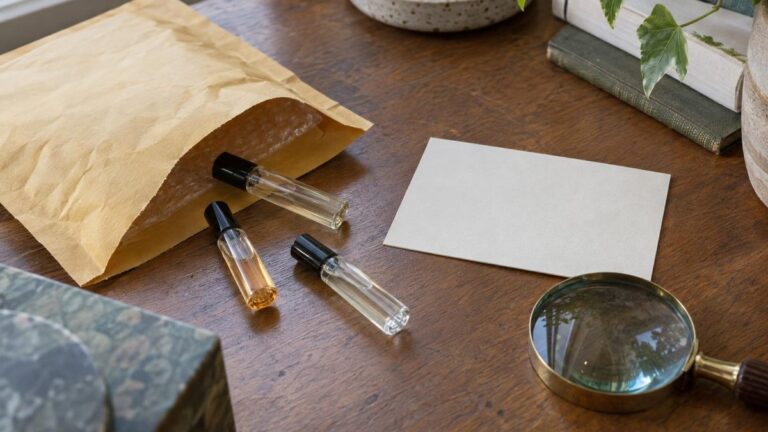
Few things beat a padded mailer from a brand holding a single vial and a card. Yet the same delivery route carries the worst samples too, sent by sellers who mimic the packaging and pour in some other liquid. This guide walks through genuine programs, counter handouts, and ways to separate a real envelope from a fake.
Launch campaigns from fragrance houses are real, though short-lived: a form goes live, the vials run out, the page vanishes, and a fresh one pops up months afterward. So instead of listing offers that would be dead before you read this, the guide describes how the pattern works.
- How brand sample forms and mailing lists work
- What to ask for at a department store counter
- The three signs of a scam “free sample”
- Spotting a counterfeit, with U.S. Customs’ warning
Brand Sample Forms and Mailing Lists
New releases often come with sample forms on the fragrance house’s website, pushed through social ads. Give a mailing address and expect a vial in two to six weeks. Such forms seldom get a spot in the site’s navigation, so the newsletter is your best early warning for the next one.
- The brand itself hosts the form, not a site that gathers offers from many labels.
- It asks for a name and address, perhaps an email, and nothing beyond that. No card, no postage charge, no long survey.
- The brand’s own domain sends the confirmation email, and the parcel carries the brand’s return address.
- Households normally get a single vial. A page promising a full-size bottle is not a sample program.
Counters: Ask After the Blotter
Vials for most displayed scents sit behind department store and specialty counters. Spray two or three onto blotter strips, pick a favorite, then ask whether a sample can go home with you for a full day of wear. Each store lists fragrance gifts on its promotions page, for instance Nordstrom’s gifts with purchase, where a deluxe mini often appears after a spending minimum. For the two specialty chains in depth, read our Sephora versus Ulta comparison.
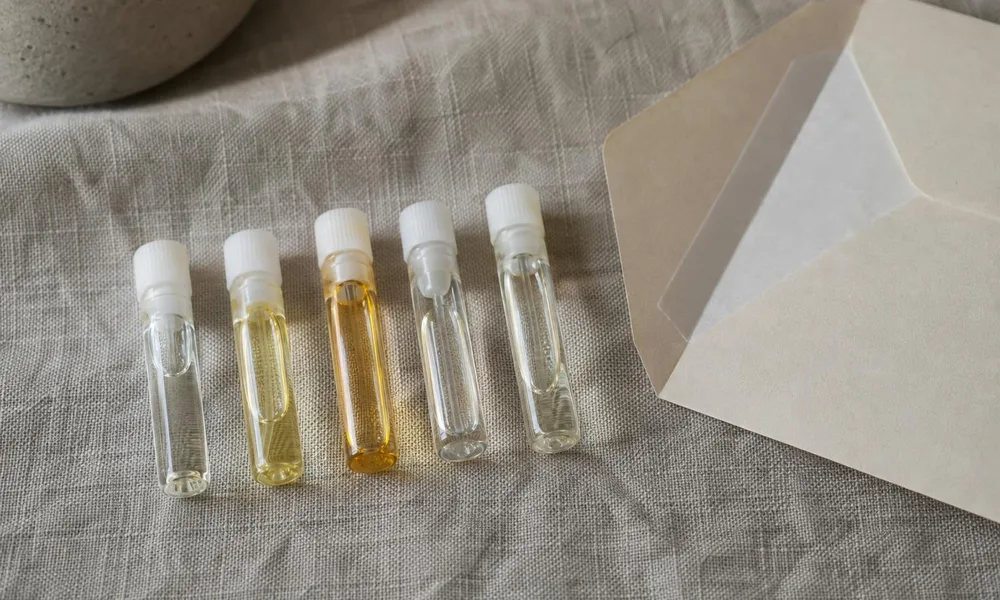
The Three Signs of a Scam Sample
The FTC guide to free trials lays out the mechanism. A modest postage charge gives the seller your card number, and a charge at full price comes next, often again each month. Fragrance offers of this kind have three telltale signs.
- Postage charges. Real sample programs pay their own shipping.
- Card details requested. Sending a vial never calls for them.
- A countdown timer or a stock tracker. Urgency is the product being sold.
If a charge appears regardless, follow the CFPB’s advice and contest it with your card issuer, then file a report on the seller at ReportFraud.ftc.gov.
Spotting a Counterfeit
Shipping containers of fake perfume are regularly caught by U.S. Customs and Border Protection. One seizure announcement warned that counterfeit scents may contain unidentified chemicals, and that many knockoffs are poorly made and may injure people. The Fake Goods, Real Dangers page shows that more than money is at stake.
- Order from the brand itself, an authorized dealer or a department store. If a marketplace seller undercuts retail by a wide margin, that is your first red flag.
- Look closely at the box. Blurry print, typos, a missing batch code or loose wrapping are common on fakes.
- Compare the bottle with the brand’s own photos. Cap weight, glass clarity and the finish on the sprayer are tough to copy.
- Your sample is the yardstick, because vials handed out by a brand or counter are authentic. A full bottle that smells weak, or that turns harsh soon after spraying, should be set aside.
Paying for the Full Bottle Safely
Buy fragrance with a credit card, not a debit card or bank transfer. Dispute rights as the CFPB describes them cover card purchases, which helps when a bottle proves counterfeit. On buy-now-pay-later plans, and what a return does to them, the CFPB explainer has the details. Hang onto the box and receipt for the first few wears. This is general information rather than financial advice.
Samples by Mail at a Glance
| Source | What arrives | Red flag |
|---|---|---|
| Brand sample form | One vial, a card | Shipping fee or card number |
| Brand newsletter | Launch samples, sometimes a mini | Form hosted off the brand’s domain |
| Department store counter | A vial on request | None; just ask |
| Marketplace seller | Unknown contents | Price far below retail |
| Subscription box | A paid decant each month | Hard-to-stop renewal |
Frequently Asked Questions
How do I find brand sample forms?
Join the mailing lists of houses you like, and keep an eye on their social accounts as launches approach. Forms disappear fast and almost never sit in the site menu.
Is a sample that charges shipping ever legitimate?
A handful of discovery sets do charge a modest fee that is later credited against a full bottle, and they state it openly. But a “free” sample that bills postage and gives nothing back is precisely the pattern the FTC warns about.
How can I tell a fake perfume?
Watch for a price far below retail, careless box printing, a missing batch code, and a scent that thins out or turns sharp within minutes. Buy only from the brand or an authorized store.
What do I do if a seller keeps charging me?
Start by putting your cancellation in writing. Next, contest the charge with your card issuer, and file a report on the seller with the FTC.